
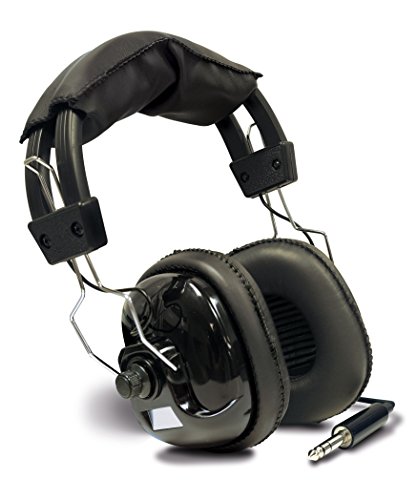
Bounty Hunter Metal Detector Headphones
Headphones are the cheapest upgrade that actually improves finds: they surface faint, deep signals the speaker loses to wind and traffic, cut battery drain, and need a 1/4-inch jack, not the 3.5 mm one on phones.
Headphones are the cheapest upgrade that changes what you find. The built-in speaker loses faint signals to wind, traffic and your own footsteps - and faint signals are usually the deep ones. Plug in headphones and targets you would have walked past become obvious. They also stop the detector announcing every hit to everyone in the park, and they cut battery drain, because driving a speaker costs far more power than driving a pair of earcups.
Headphones are one add-on; for functional spares and wear items, see our Bounty Hunter parts guide.
Check the jack before you order
This is where most orders go wrong. Metal detectors traditionally use a 1/4-inch (6.35 mm) headphone jack, the large connector familiar from guitar amps, while phones and laptops use 3.5 mm. Detector-specific headphones usually ship with the 1/4-inch plug, sometimes with an adapter in the box.
Look at your control box before buying. If the socket is the large type and your headphones are the small type, you need an adapter - and be aware that a rigid adapter sticking out of the control box is the part most likely to break when the detector goes into a car boot. A model with the correct plug already fitted is worth the small extra cost.
Which Bounty Hunter models take a standard headphone jack
One model breaks the pattern above, so check this before you order a set:
| Detector | Headphone jack | Works with the HEAD-PL headphones below |
|---|---|---|
| Junior | No headphone jack supported | No - excluded from the maker's own compatibility list |
| Every other current model (Tracker IV, Gold Digger, Quick Draw II, Sharp Shooter II, Quick Silver, Fast Tracker, Platinum, Land Ranger Pro, Lone Star Pro, Discovery 3300, Time Ranger Pro) | 1/4-inch (6.35 mm) stereo | Yes - plugs in directly, no adapter needed |
If you are buying for a child's Junior, budget for the built-in speaker rather than a headphone set - everything else in the lineup takes the standard jack described above.
Why detector headphones differ from music headphones
Music headphones are tuned to sound pleasant across the whole frequency range, with emphasis on bass. Detector tones sit in the mid-range, and bass emphasis actively works against you - it muddies exactly the band you are listening to.
Detector headphones do the opposite: they push the mid-range forward so a weak, wavering tone stands out from the hum of the machine. Many also have large earcups that seal out ambient noise passively, which matters more than any electronic trickery when you are next to a road.
Volume control on the cup is worth having. Ground conditions change during a hunt, and reaching for the control box every time is a nuisance.
Wired or wireless
Wired is still the default for good reason: no pairing, no charging, no latency. On a detector, latency matters - a delay between the coil passing a target and the tone reaching your ears makes pinpointing harder, and cheap Bluetooth adds exactly that.
Wireless options exist and work well when the detector supports a low-latency protocol, but if your machine has a standard headphone socket and no wireless module, a wired pair is the simpler and cheaper answer. The cable is also one less thing to charge before a hunt.
What to look for in a set
- Correct connector for your model, or an adapter you are happy to use
- Closed-back cups that seal against ambient noise
- Volume control on the cup, ideally per side
- Coiled or reinforced cable - straight cables snag on brush and pull out of the socket
- Foldable or collapsible if they travel in the same bag as the detector
Weather resistance is worth having if you hunt beaches or wet fields, but full waterproofing is only relevant if you are diving the coil - which most Bounty Hunter models are not built for anyway.
Care and lifespan
Headphone cables fail at the plug, almost without exception. Unplug by the connector rather than pulling the cable, and coil the lead loosely rather than winding it tight around the cups. If the cable is detachable, keep a spare - it costs a fraction of a new set.
Foam earpads compress and crumble after a couple of seasons of sweat and sun. Replacement pads are inexpensive and restore both comfort and the seal that keeps ambient noise out.
Popular options on Amazon
Prices change often - check the current price on Amazon.

Frequently Asked Questions
Will any headphones work with a Bounty Hunter detector?
What size jack do Bounty Hunter detectors use?
Do headphones really extend battery life?
Are wireless headphones a good idea for detecting?
Does the Bounty Hunter Junior work with headphones?
Ready to check the latest price?
Check Headphones on Amazon