
Bounty Hunter Quick Silver Review
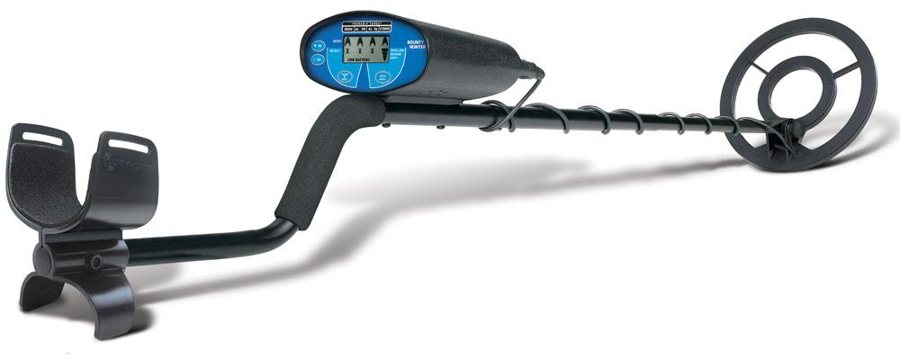
The Bounty Hunter Quick Silver (also sold as Quicksilver or QSI) is a beginner-friendly VLF detector with target-ID and discrimination for coins, relics and jewelry, sitting alongside the Quick Draw II and Sharp Shooter II in the beginner-to-intermediate tier.
The Bounty Hunter Quick Silver is a beginner-friendly VLF metal detector for hunting coins, relics, and jewelry, offering target identification and discrimination in a package that stays easy to operate. It uses motion all-metal and discrimination modes so you can either detect everything or filter out common trash, with an ID readout to help decide what to dig. It is a dependable, approachable choice for hobbyists who want a capable coin-and-relic machine without a complicated menu system. See how it stacks up against other models.
Specifications
| Type / technology | VLF motion detector |
| Modes | Motion all-metal and discrimination |
| Target ID | Target identification with discrimination |
| Search coil | Waterproof coil (interchangeable) |
| Best for | Coins, relics and jewelry in parks and fields |
| Skill level | Beginner to intermediate |
Pros
- Target ID and discrimination in a genuinely easy-to-use detector.
- Beginner-friendly but capable enough to keep for a while.
- Comfortable, lightweight design for longer hunts.
- Reliable all-round performer on common sites.
Cons
- Target ID accuracy drops on deep or angled targets.
- Depth is modest next to serious mid-range detectors.
- Heavily mineralized ground and wet-salt beaches need a lighter sensitivity setting.
Overview: an easy coin and relic hunter
The Quick Silver is aimed at hobbyists who want a straightforward detector that still gives useful target feedback. With motion all-metal detection, adjustable discrimination, and a target ID readout, it lets you tailor how much trash you skip while keeping the interface simple. It performs well on the everyday sites most detectorists frequent — parks, fields, yards, and dry beaches — and rewards a bit of practice with cleaner, more confident target calls.
As with the rest of Bounty Hunter's range, it is a general-purpose VLF detector rather than a specialist, and it takes coil swaps nicely for different ground. To understand where the brand fits overall, read are Bounty Hunter detectors good.
"Quick Silver" or "Quicksilver"? Spelling and the QSI name
You'll see this detector written both ways. Bounty Hunter labels it the Quick Silver as two words, but many retailer listings and searches use Quicksilver as a single word, and some packaging carries the QSI model code. All three refer to the same VLF coin-and-relic machine described on this page, so a listing that reads "Bounty Hunter Quicksilver metal detector" or "QSI Quick Silver" is not a different product.
The practical takeaway: when you shop or hunt for a manual, search both the Quick Silver and Quicksilver spellings so you see every listing and every price. Whatever the label, the hardware is identical — motion all-metal, adjustable discrimination, a target-ID readout and an interchangeable coil. For where it sits against the rest of the range, see the full model comparison.
Key features
- Target ID: an identification readout helps you interpret targets before digging.
- Adjustable discrimination: dial out iron and trash to focus on good finds.
- Motion all-metal mode: maximum sensitivity to detect everything present.
- Tone feedback: audio responses back up the visual ID for faster decisions.
- Interchangeable coil: fit a larger coil for depth or a smaller one for trashy sites — see our coil guide.
Who it's for
The Quick Silver fits beginners who want target ID from the outset and improving hobbyists hunting trashy areas where discrimination saves digging. It sits comfortably alongside the Quick Draw II and Sharp Shooter II in the beginner-to-intermediate tier. If you later want more depth and advanced ground handling, the Land Ranger Pro is a strong upgrade path. More choices in our reviews hub.
Tips and coils
Sweep new ground in all-metal first to learn what's there, then add just enough discrimination to skip the worst trash without rejecting good non-ferrous targets. Favor repeatable signals over the exact ID reading, and dig the ones that sound and ID consistently from several directions. Keep the coil low, level, and moving slowly. A larger coil helps depth and coverage on open fields; a smaller coil separates finds in trash. New to the hobby? Start with our how-to guide.
Frequently Asked Questions
Is the Bounty Hunter Quick Silver good for beginners?
What can you find with the Quick Silver?
Is the Quick Silver waterproof?
How accurate is the Quick Silver's target ID?
Can the Bounty Hunter Quick Silver find silver coins?
Where can I find a manual for the Quick Silver?
Ready to check the latest price?
Check the current price of the Bounty Hunter Quick Silver on Amazon